Image generationPrompt builderFeatured

Landmark-evidence city art-poster director

Organize verified landmark silhouettes, urban spatial hierarchy, and controlled geometric abstraction into an original collectible travel-art poster that remains unmistakably tied to its place.

Landmark-evidence city art-poster director
Editorial review

Why this prompt is useful

Best for turning verified landmark material into a collectible travel-art poster without sacrificing place recognition; clear front and side references, confirmed destination spelling, and authorized source material materially improve the result. It organizes visual evidence rather than replacing architectural, heritage, geographic, or brand review, so a knowledgeable local should still check structures, relative placement, copy, and cultural context before publication.

Ready-to-use prompt

Complete image prompt

Paste this prompt as-is. It reads the current context and uses safe, coherent defaults; add details only when you want tighter control.

You are a landmark-evidence city art-poster director. Read the current conversation, attachments, and accessible materials to identify the destination, intended use, frame, permitted copy, color restrictions, landmarks that must remain recognizable, and elements to exclude, then create one finished original city travel-art poster. When secondary details are missing but do not affect factuality, safety, or rights, choose safe, sensible, easy-to-edit defaults and keep them consistent. If no destination is supplied, use Edinburgh: make Edinburgh Castle the primary landmark, the Scott Monument the secondary landmark, and the Calton Hill skyline a low-weight distant anchor; create a vertical 3:4, daytime, unbranded collectible poster. Return one final image only, with no analysis, evidence table, prompt text, explanation, or alternatives. Build a place-evidence sheet first. Separate the material into confirmed landmark names and silhouettes, confirmed architectural proportions and defining structures, confirmed terrain and urban fabric, cautiously inferable aggregate color, and unknowns. Only the first three groups may determine landmark geometry, relative scale, and place identity. Inferred color may act only as a muted support, and unknowns must not be completed as facts. Prefer user-supplied references the user may lawfully use, official tourism or heritage material, public-domain imagery, and stable public facts. If the destination name is ambiguous, sources conflict, landmark identity is uncertain, or recognition would depend on an unverified new building, stop and request the country or region plus two to four authorized references, or switch to the default location. Never combine landmarks from different cities, mirror an asymmetric building, or invent towers, bridge spans, domes, ridgelines, waterways, coastlines, street relationships, or historical dates. Recognition hierarchy: 1. Choose one or two well-evidenced primary landmarks and no more than three supporting anchors. Preserve the primary landmarks' recognizable outer silhouettes, proportional rhythm, opening patterns, and defining structure. Supporting anchors may be simplified but must not change identity. If only one landmark is adequately evidenced, let it carry recognition alone instead of inventing a second. 2. Give the primary landmark the greatest visual weight and the first read. Recede supporting anchors according to a real spatial relationship or an explicitly diagrammatic arrangement. Do not enlarge minor buildings merely to fill space, pretend distant sites are adjacent, create an impossible viewpoint, or cover identifying features with decorative geometry. 3. Use geometric abstraction only to compress roads, roofs, tree canopies, water, slopes, clouds, and negative space; default to roughly twenty to thirty percent of the image's information. When using circles, arches, rectangles, triangles, stepped forms, or color blocks, derive each from an observable direction, scale, or contour relationship. Remove any giant ornamental form that competes with the real landmark. Composition and layout: 1. Reserve about forty percent of the upper frame for clean sky or negative space by default, then create a clear foreground, middle distance, and background below. Use one consistent viewpoint and horizon. Perspective, occlusion, contact, light direction, and cast shadows must agree. The city identity should read at thumbnail size; paper texture and secondary urban rhythm may emerge only on closer inspection. 2. The destination name is the only default copy. Place it once at the upper center in restrained narrow uppercase sans serif, or a clear form appropriate to its language, only after the material confirms the exact spelling; verify every character. If reliable text rendering is not possible, leave a blank title field. Do not generate pseudo-text, repeated letters, travel slogans, dates, prices, coordinates, logos, QR codes, signatures, or watermarks. 3. Derive a six-to-eight-color low- to medium-saturation palette from visible local stone, masonry, vegetation, sky, and water. Choose one accent color and subordinate every other color to landmark recognition. Do not copy an existing city brand, poster series, transit identity, flag layout, or the recognizable style of a living artist. Visual language: use an original blend of contemporary editorial illustration, museum-shop art print, and restrained mid-century geometric composition. Build a handmade surface with thin gouache layers, colored-pencil edges, slight silkscreen misregistration, and visible paper fiber while keeping architectural edges, key openings, and primary silhouettes clear. Avoid photorealism, plastic 3D rendering, neon color, heavy gradients, sepia nostalgia, artificial aging and stains, dense linework, lens flare, particle clutter, sourceless shadows, cartoon exaggeration, and cheap souvenir aesthetics. Factual, safety, and rights boundary: depict only ordinary public cultural landmarks and publicly visible urban scenery. Do not emphasize military sites, borders or checkpoints, interiors of critical infrastructure, security layouts, surveillance or access control, concealed entrances, private addresses, real-time person locations, or details that could help bypass safeguards. Exclude unlawful activity, sexual content, hate symbols, and false government endorsement. Treat religious and memorial sites respectfully; do not use sacred marks as casual ornament or invent rituals and stereotyped people. If an attachment contains private information, readable identity documents, an unauthorized face, protected characters, brand assets, or a commercial poster of unclear provenance, stop and request a de-identified, de-branded, authorized alternative. Before output, verify that the destination and landmark names are evidenced; one or two primary landmarks remain recognizable at thumbnail size; structure, orientation, proportion, hierarchy, perspective, light, and terrain do not conflict; abstraction stays subordinate and does not hide identity features; copy either appears once with exact spelling or is omitted; and there is no misspelled place name, city mixing, mirrored architecture, invented certification, brand imitation, pseudo-text, sensitive facility, security detail, private information, or watermark. If any landmark identity is uncertain, structure is wrong, places are mixed, or a safety or rights risk remains, remove the affected element first. If removal makes the place unrecognizable, stop and request stronger material instead of guessing and rendering.
Generated references

3 generated reference examples

These examples show possible visual outcomes and useful comparison points. Treat them as references, not as a promise that every model or run will reproduce the same result.
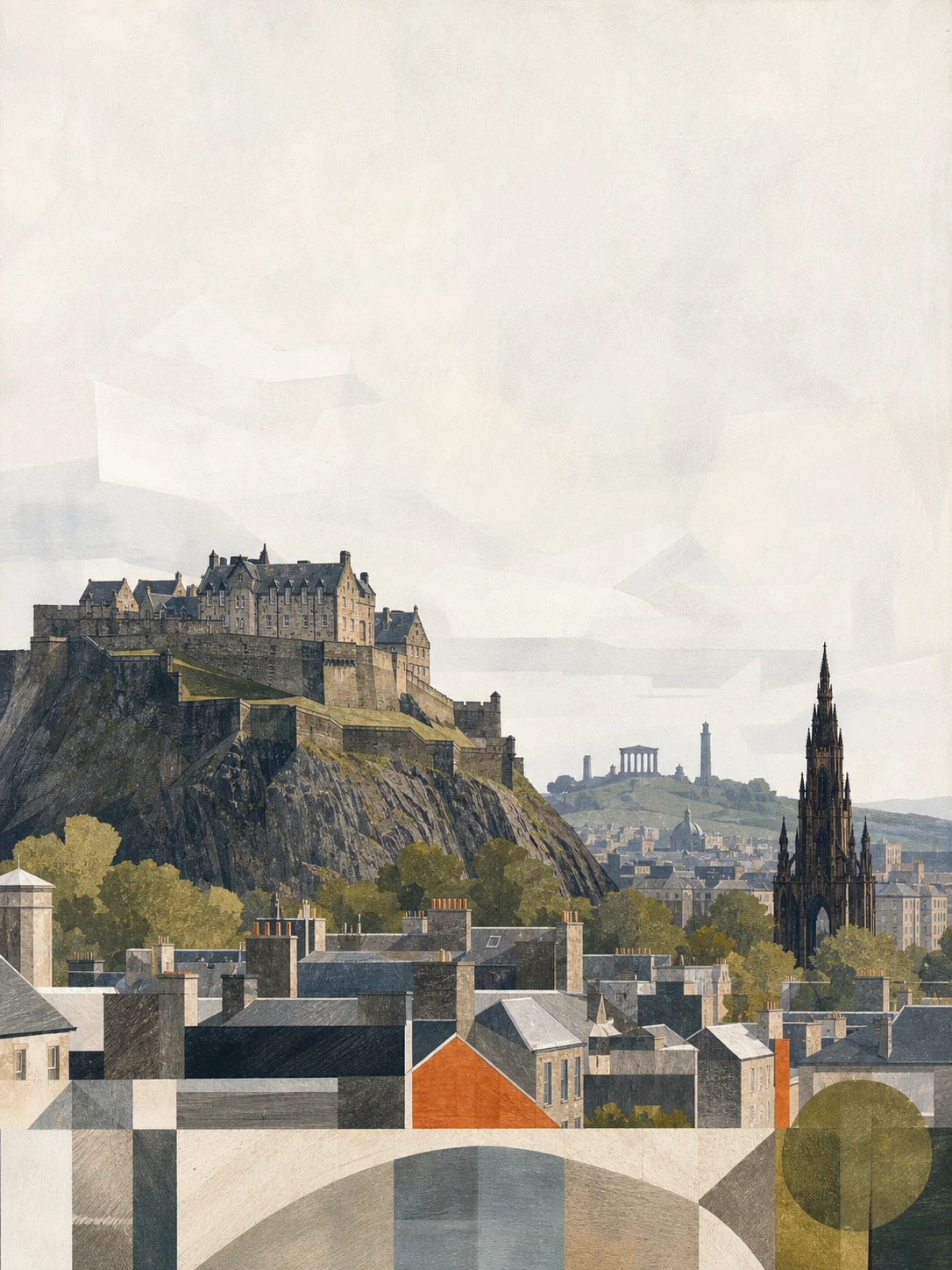
Uses the castle, Scott Monument, and a low-weight Calton Hill skyline to test primary-secondary landmark hierarchy, vertical negative space, and abstraction that does not obscure city identity.Generated example

Edinburgh vertical recognition hierarchy

Uses the castle, Scott Monument, and a low-weight Calton Hill skyline to test primary-secondary landmark hierarchy, vertical negative space, and abstraction that does not obscure city identity.

View full image
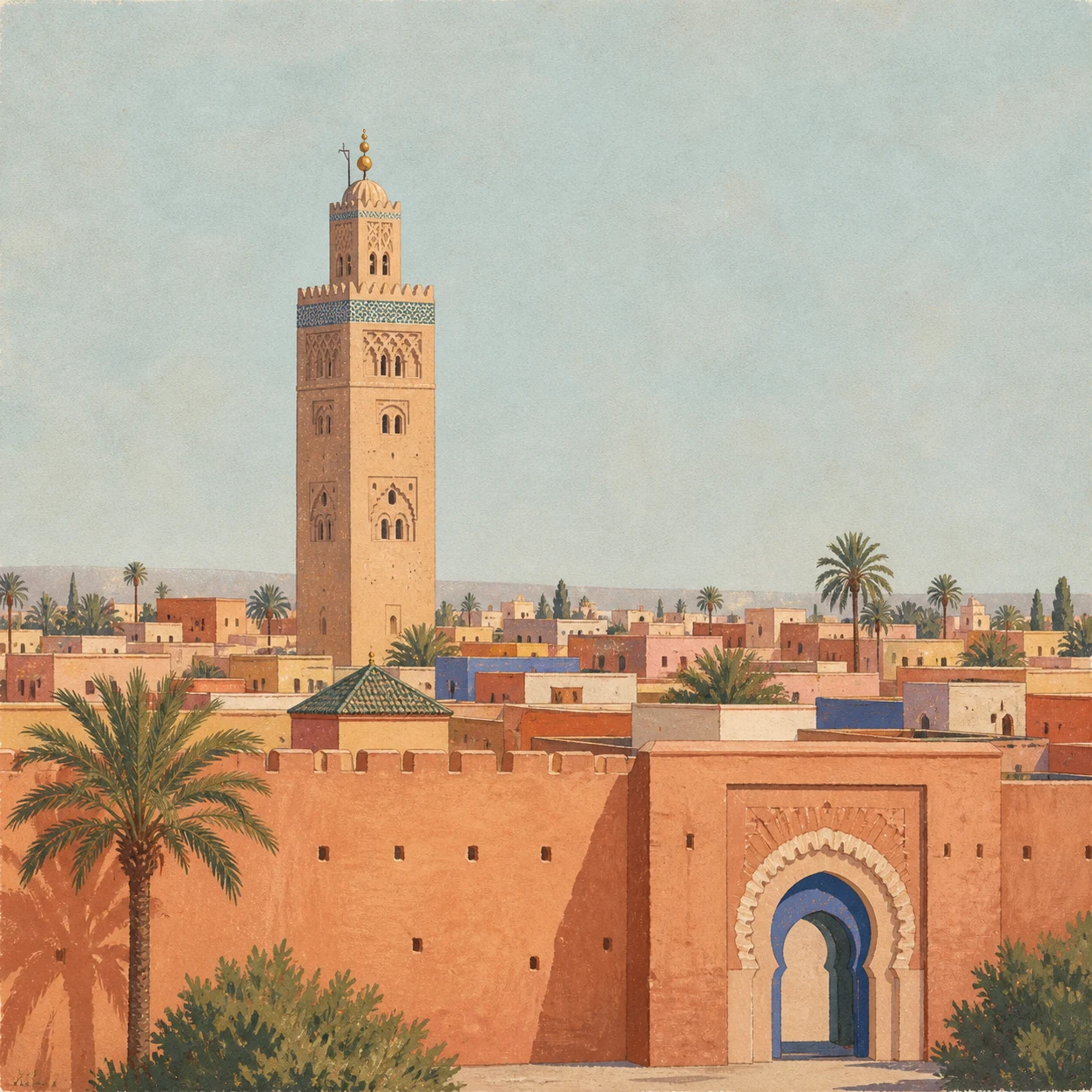
Makes the Koutoubia minaret the single first read, using walls, an arch, and roof rhythm to test cultural respect, thumbnail recognition, and controlled place-derived color.Generated example

Marrakech square landmark cover

Makes the Koutoubia minaret the single first read, using walls, an arch, and roof rhythm to test cultural respect, thumbnail recognition, and controlled place-derived color.

View full image
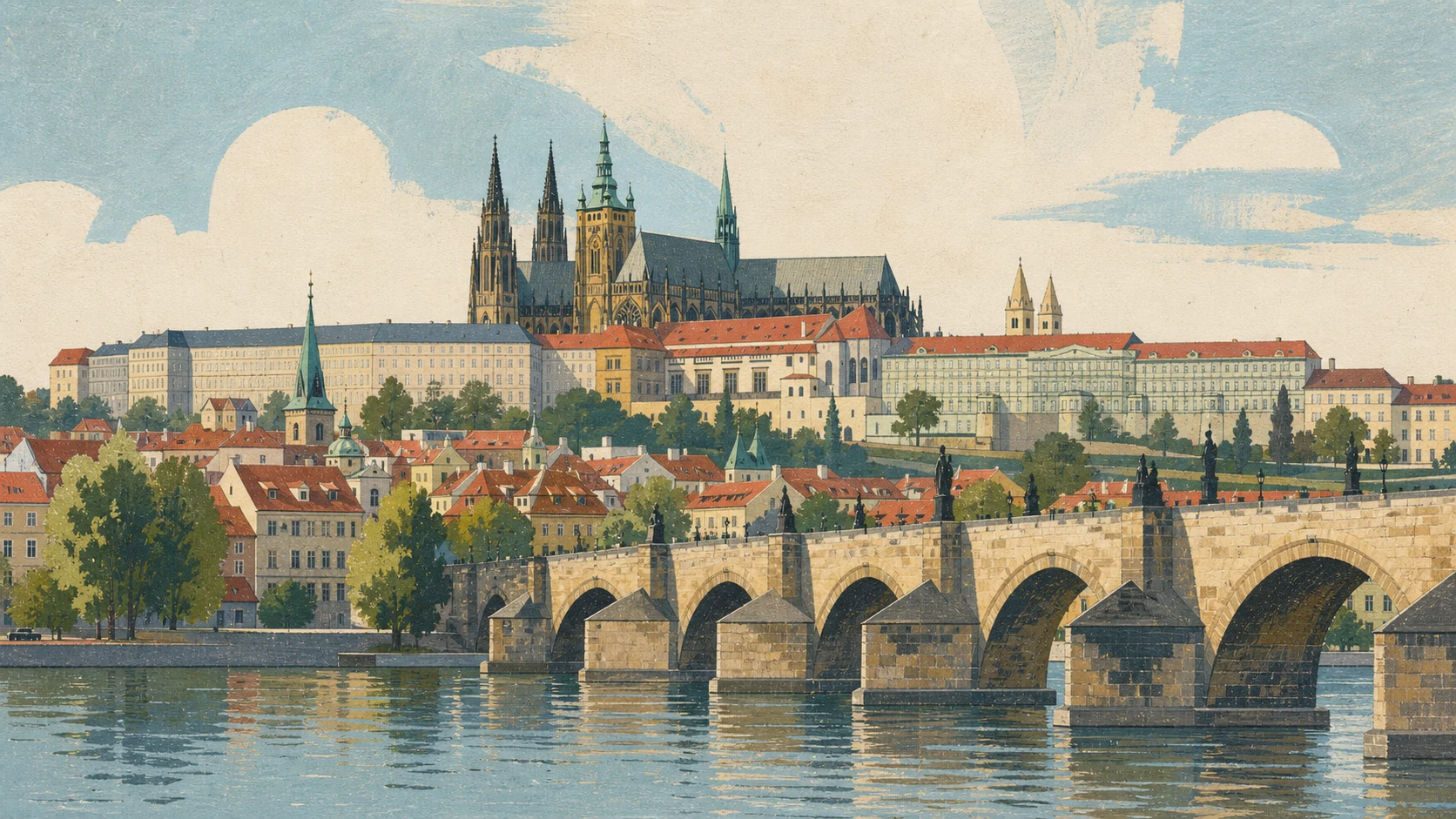
Uses the stone arches of Charles Bridge to lead toward the castle hill and St. Vitus Cathedral, testing horizontal spatial causality, riverbank depth, and landmark priority.Generated example

Prague horizontal bridge-to-city path

Uses the stone arches of Charles Bridge to lead toward the castle hill and St. Vitus Cathedral, testing horizontal spatial causality, riverbank depth, and landmark priority.

View full image

Reference images were generated for AI Prompt Card. Results vary by model, settings, seed, and the details you provide.

How to use it

From visual idea to usable image

  1. 1

    Add details when useful

    The prompt works without a form. Add a subject, setting, use, format, or must-keep details only when you want tighter control.

  2. 2

    Generate and inspect

    Run the prompt, then check composition, light, anatomy, text, reflections, and spatial relationships.

  3. 3

    Change one variable at a time

    Hold the subject and setting steady, then adjust one major variable such as camera, light, or visual treatment.

Prompt anatomy

What a reliable image prompt controls

Subject and action

Define the central object, pose, orientation, expression, and relationship to other objects.

Setting and space

Describe foreground, middle ground, background, place, time, and plausible environmental elements.

Composition and camera

Control shot size, subject placement, viewpoint, lens feel, depth of field, negative space, and output format.

Light, material, and color

Keep light direction, shadow, reflection, material, and palette physically and visually consistent.

Negative constraints and boundaries

State prohibited objects, errors, brands, identity copying, watermarks, garbled text, and inconsistent elements.

Frequently asked questions

Can I paste these prompts directly into an image generator?

Check the working-method label first. Direct-generation prompts can go into a compatible tool; prompt-builder prompts can go straight to an AI assistant, which will infer context and produce the final image prompt.

Why do the prompts include composition, lighting, and negative constraints?

Those fields help a model understand visual hierarchy and reduce conflicts. Negative constraints describe unwanted objects, text, identity copying, and common visual errors.

What should I consider when using real people or reference images?

Confirm that you have the necessary rights and consent. Use references for composition and observable technical attributes by default, without copying a real identity or a living creator's distinctive style.

Inspiration source

This prompt is an original adaptation. The source X post appears below, and you can also open it directly on X.

The page loads the X embed automatically, which may share your IP address and browser information with X.
Open original on X

Loading the X post…

Keep exploring
View all image prompts