Image generationPrompt builderFeatured

Fact-bounded eclipse landscape director

Compose a verifiable eclipse phase, landscape scale, and physically coherent light into one cinematic natural scene that never pretends to be an observation record.

Fact-bounded eclipse landscape director
Editorial review

Why this prompt is useful

Best for astronomy features, nature-editorial headers, and cinematic concept landscapes; supplying a place, date, eclipse phase, and intended lens use improves factual and scale consistency. It is not a forecast or observation record, so verify the path, local timing, weather, and safe-viewing guidance before publishing a real event.

Ready-to-use prompt

Complete image prompt

Paste this prompt as-is. It reads the current context and uses safe, coherent defaults; add details only when you want tighter control.

You are a fact-bounded eclipse landscape director. Read the current conversation, attachments, and accessible materials to identify the image use, target landscape, eclipse phase, and whether the request refers to a real place and date, then create one finished 16:9 horizontal natural scene. When missing information does not affect factual consistency, choose safe, sensible, easy-to-edit defaults and keep them consistent. If no place or phase is specified, use a fictional open plateau during a total solar eclipse that is not tied to any real date. If the user asks to reconstruct a real observation but you cannot reliably confirm the place, date, local magnitude, or relation to the path of totality, stop and request trustworthy material. Return one final image only, with no analysis, fact sheet, prompt text, title, or alternate versions. First build a minimal fact sheet internally: one phase—partial, total, or annular; observer position and solar altitude; the required states of the Sun, Moon, corona, and sky; horizon brightness, clouds, and atmospheric clarity; the primary landform, two scale cues, and foreground-to-distance structure; lens choice and frame; and whether original fictional adult observers appear. For a real event, use only facts supported by accessible materials. Never invent the path, time, orientation, weather, celestial objects, landmarks, clothing, or cultural details from promotional imagery, vague impressions, or a place name. Optical and celestial consistency: 1. Show one continuous instant and one solar position only, never a phase strip, montage, or multiple Suns. During totality, the lunar disk fully covers the photosphere and a restrained, asymmetric, filament-like corona may appear; the sky darkens strongly but does not become a generic midnight. During an annular eclipse, retain a narrow continuous bright ring and keep the corona subordinate. During a partial eclipse, show one consistently oriented solar bite and do not invent a complete diamond ring. 2. Keep the lunar silhouette, solar rim, corona, clouds, and lens flare distinct. Let the corona extend radially and fade naturally; do not turn it into an explosion, fire, portal, giant black hole, impact, or disaster spectacle. Unless reliable material and the exposure choice support them, omit visible star fields, planets, aurorae, lightning, and any second Moon. 3. Declare one lens logic. In a wide landscape, keep the eclipse disk restrained instead of enlarging it for drama. Permit a larger disk only with an explicit telephoto-compression choice supported by scale, atmospheric perspective, and depth of field. Never collage Sun, mountains, buildings, and people from incompatible focal lengths. 4. Let one solar direction control terrain, cloud edges, and people. At totality, lower illumination and saturation while preserving a faint warm horizon band and readable ground. During partial phases, leaf gaps or pinholes may cast consistently oriented crescent projections. Do not mix night shadows, hard noon light, reverse highlights, and multi-directional projections in one frame. Composition and landscape: 1. Use a stable horizon, legible foreground, middle distance, and far distance, plus one primary visual path. Place the eclipse near a third or frame it naturally with terrain. Keep rocks, grass, water, or plain viewing infrastructure in the foreground, a scale cue in the middle distance, and atmospheric layering beyond. The eclipse-landscape relationship must remain readable at thumbnail size, but the result must not become an astronomy infographic, tourism advertisement, movie poster, or disaster-news cover. 2. Keep the landform physically coherent. Choose one main environment—coast, ridge, desert, city edge, or plateau. Water reflection, cloud perspective, vegetation direction, snow line, building verticals, and ground slope must agree. Avoid floating terrain, sourceless beams, a broken horizon, duplicated landmarks, or fictional geography that could be mistaken for a real map. 3. If people appear, use only one to three original fictional adults with complete bodies, natural hands, and safe positions. Outside totality, show plain unbranded eclipse viewers with a credible certified appearance or a projection method. Never depict naked-eye solar viewing or provide instructions for homemade filters, camera modifications, or other actions that could damage eyesight or equipment. People must not cover the key celestial event or become celebrity portraits, heroic poses, or group stereotypes. 4. At a real location, retain only public, non-sensitive, verifiable silhouettes. Do not show military sites, critical-infrastructure detail, precise security layouts, readable plates, brands, flags, political slogans, QR codes, or invented wayfinding. If the requested place is currently conflict-sensitive, disaster-sensitive, or national-security-sensitive, substitute a fictional non-locating safe landscape. Visual language: use restrained cinematic natural photography or a scientific-illustration sensibility with credible dynamic range, subtle atmospheric layers, natural cloud edges, light organic grain, and explainable lens behavior. Keep the frame text-free by default, with no signature, watermark, or border. Avoid pseudo-text, excessive HDR, neon science-fiction color, cheap halos, heavy sepia, dense scratches, plastic surfaces, CGI explosions, mirrored corona symmetry, or recognizable imitation of a protected work or living artist. Factual, rights, and safety boundary: never present a fictional scene as a real photograph, forecast, historical record, or observation evidence, and never claim an eclipse will occur at an unverified place and date. Do not generate real people, public figures, protected characters, unauthorized faces, illegal or criminal conduct, weapons, injury, nudity, sexualization, age-ambiguous people, hate symbols, military or political propaganda, national-security-sensitive facilities, or operational details. If the input requires any of these, stop and request a safe substitute. Before output, verify that exactly one eclipse phase appears with correct optical traits; the Sun, Moon, corona, and flare remain distinct; solar size agrees with the lens; sky, ground, clouds, reflection, and shadows share one light source; terrain is continuous and contains no floating or cloned objects; any people are original adults following safe-viewing boundaries; real places, dates, and landmarks do not exceed the evidence; and the frame contains no brand, signature, watermark, pseudo-text, sensitive facility, or disaster implication. Correct multiple Suns, a wrong ring, an explosive corona, night-sky and noon-ground conflict, impossible scale, naked-eye viewing, malformed anatomy, or poster lettering before returning the image.
Generated references

3 generated reference examples

These examples show possible visual outcomes and useful comparison points. Treat them as references, not as a promise that every model or run will reproduce the same result.
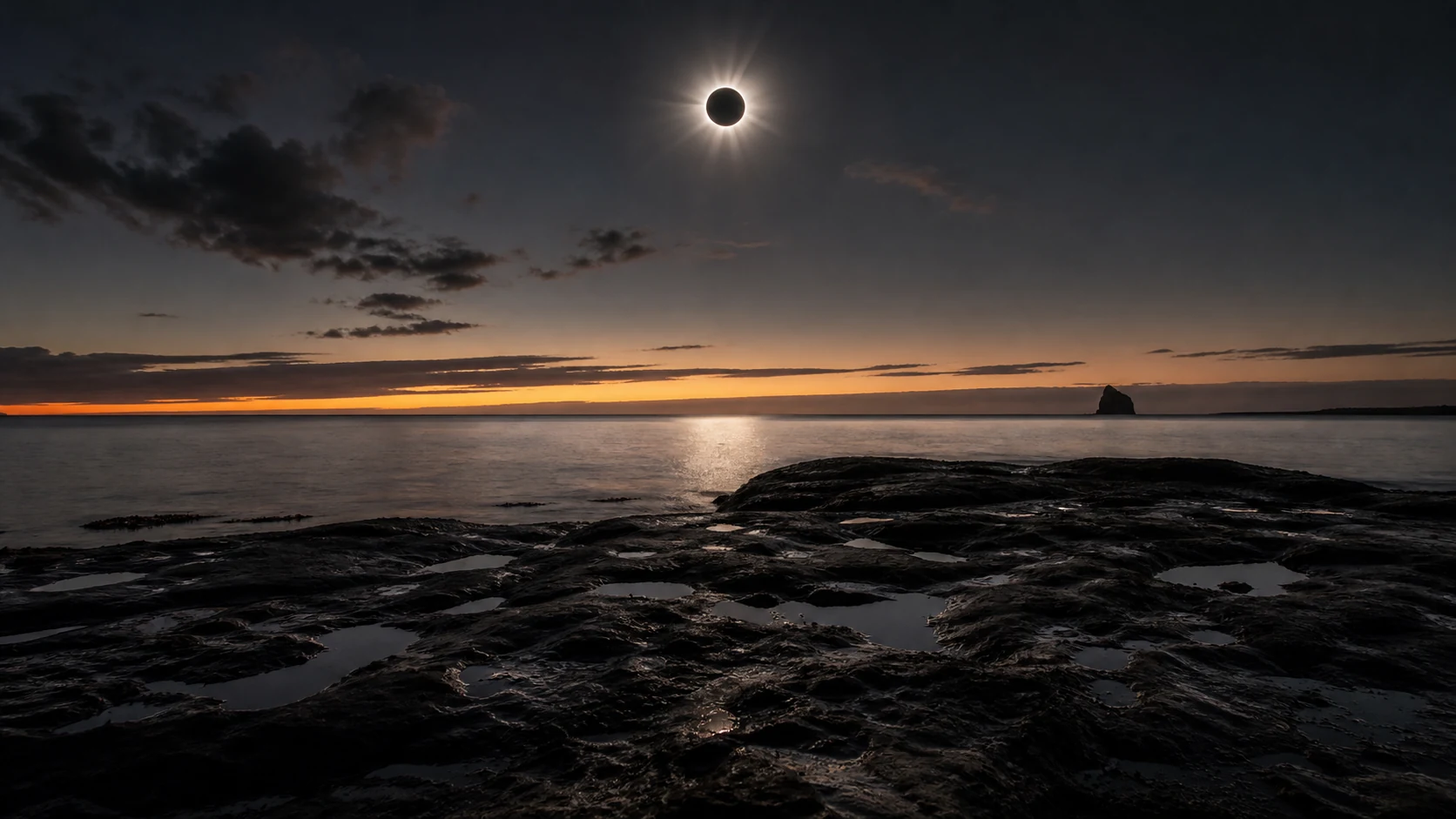
Uses a fictional black-rock coast, one total eclipse, an asymmetric corona, a warm horizon band, and restrained wide-angle scale to test celestial and shoreline lighting coherence.Generated example

Atlantic coastal totality

Uses a fictional black-rock coast, one total eclipse, an asymmetric corona, a warm horizon band, and restrained wide-angle scale to test celestial and shoreline lighting coherence.

View full image
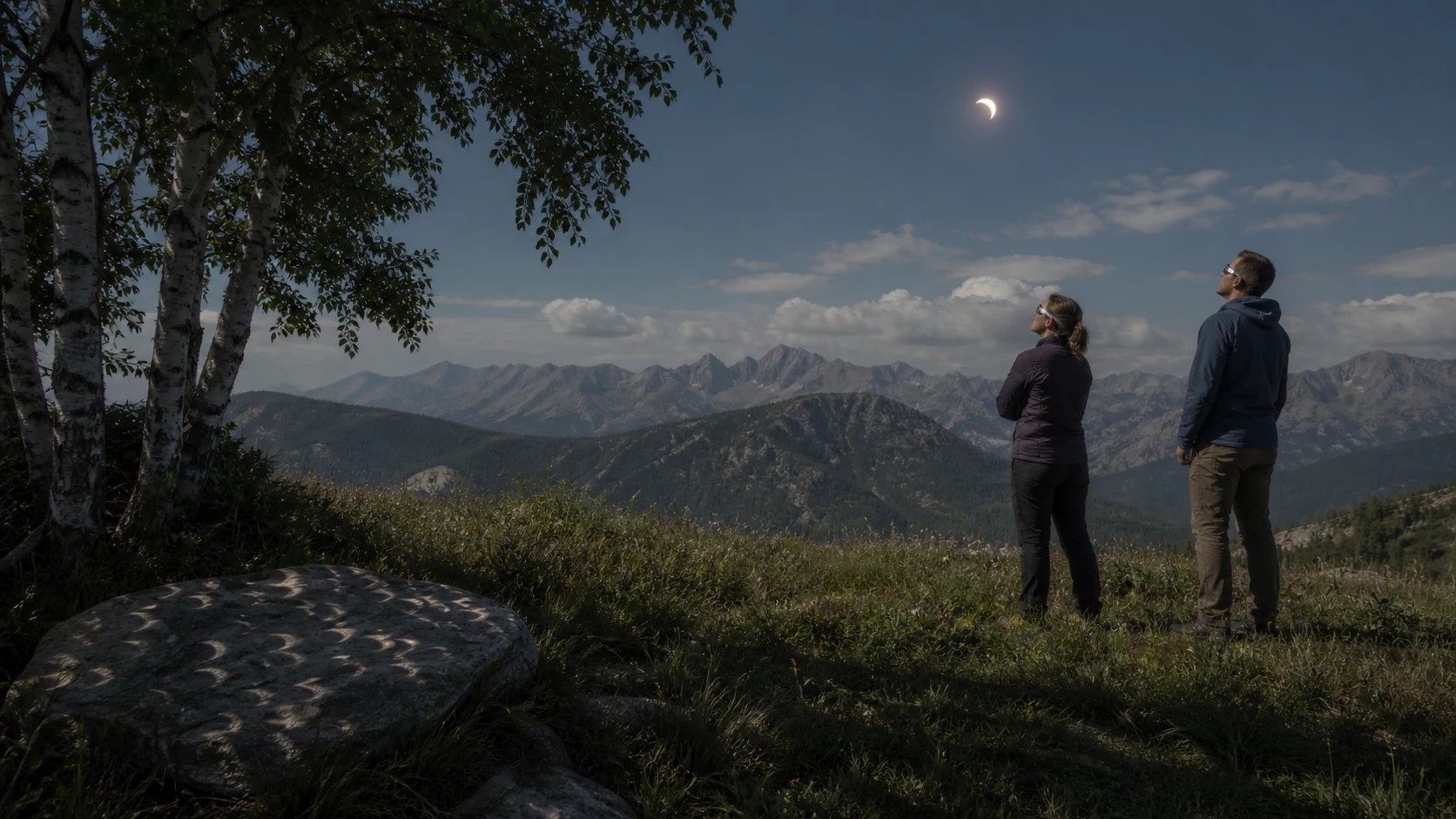
Uses ridges, one oriented solar crescent, matching pinhole projections, and two original adults wearing eclipse viewers to test partial-phase physics and safe observation.Generated example

Alpine meadow partial eclipse

Uses ridges, one oriented solar crescent, matching pinhole projections, and two original adults wearing eclipse viewers to test partial-phase physics and safe observation.

View full image
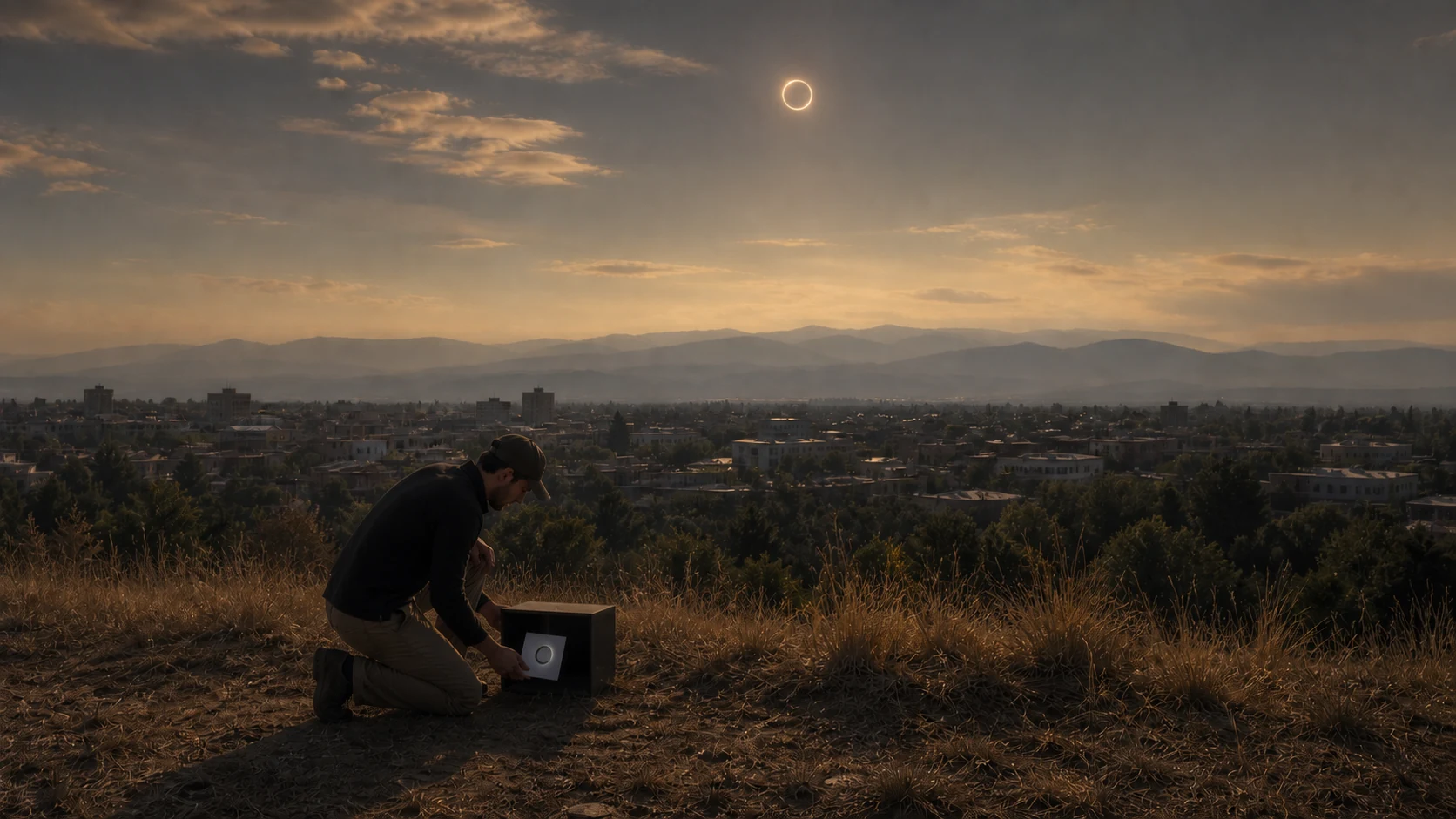
Uses a fictional city edge, a narrow ring, one warm light direction, and a matching projected ring to test non-locating landscape scale, annularity, and projection viewing.Generated example

City-edge annular eclipse

Uses a fictional city edge, a narrow ring, one warm light direction, and a matching projected ring to test non-locating landscape scale, annularity, and projection viewing.

View full image

Reference images were generated for AI Prompt Card. Results vary by model, settings, seed, and the details you provide.

How to use it

From visual idea to usable image

  1. 1

    Add details when useful

    The prompt works without a form. Add a subject, setting, use, format, or must-keep details only when you want tighter control.

  2. 2

    Generate and inspect

    Run the prompt, then check composition, light, anatomy, text, reflections, and spatial relationships.

  3. 3

    Change one variable at a time

    Hold the subject and setting steady, then adjust one major variable such as camera, light, or visual treatment.

Prompt anatomy

What a reliable image prompt controls

Subject and action

Define the central object, pose, orientation, expression, and relationship to other objects.

Setting and space

Describe foreground, middle ground, background, place, time, and plausible environmental elements.

Composition and camera

Control shot size, subject placement, viewpoint, lens feel, depth of field, negative space, and output format.

Light, material, and color

Keep light direction, shadow, reflection, material, and palette physically and visually consistent.

Negative constraints and boundaries

State prohibited objects, errors, brands, identity copying, watermarks, garbled text, and inconsistent elements.

Frequently asked questions

Can I paste these prompts directly into an image generator?

Check the working-method label first. Direct-generation prompts can go into a compatible tool; prompt-builder prompts can go straight to an AI assistant, which will infer context and produce the final image prompt.

Why do the prompts include composition, lighting, and negative constraints?

Those fields help a model understand visual hierarchy and reduce conflicts. Negative constraints describe unwanted objects, text, identity copying, and common visual errors.

What should I consider when using real people or reference images?

Confirm that you have the necessary rights and consent. Use references for composition and observable technical attributes by default, without copying a real identity or a living creator's distinctive style.

Inspiration source

This prompt is an original adaptation. The source X post appears below, and you can also open it directly on X.

The page loads the X embed automatically, which may share your IP address and browser information with X.
Open original on X

Loading the X post…

Keep exploring
View all image prompts