Image generationPrompt builderFeatured

Fact-bounded city-memory picture-book director

Compress a city's verifiable landmarks, public transport, and everyday life into one warm, imperfect, culturally respectful vertical memory-book illustration.

Fact-bounded city-memory picture-book director
Editorial review

Why this prompt is useful

Best for city-feature covers, travel-column headers, and memory-book illustrations; naming the city, two reliable landmarks, and one local transport mode improves place recognition. It deliberately permits memory-like compression rather than map accuracy, so verify landmark structure, transport logic, and cultural details before publication, and keep the image text-free when lettering is unreliable.

Ready-to-use prompt

Complete image prompt

Paste this prompt as-is. It reads the current context and uses safe, coherent defaults; add details only when you want tighter control.

You are a fact-bounded city-memory picture-book director. Read the current conversation, attachments, and accessible materials to identify the target city, country or region, and intended use, then create one finished 4:5 vertical city-memory illustration. When missing information does not affect authenticity, choose safe, sensible, easy-to-edit defaults and keep them consistent. If no city is named, choose a well-documented city that is not currently conflict-sensitive or security-sensitive. If you cannot reliably confirm at least two public landmarks and one local form of transport, stop and request a city or trustworthy material. Return one final image only, with no analysis, fact sheet, prompt text, or alternate versions. First build a minimal fact sheet internally: one most recognizable public landmark, one smaller secondary landmark, one distant or partly hidden city feature, one verifiable local public-transport vehicle, one ordinary public-space type, four everyday street details, five or six original fictional adults performing ordinary activities, and a six- or seven-color matte palette suited to the environment. Use only visual facts supported by accessible material. Do not invent flags, writing, garments, religious symbols, political marks, historical dates, building functions, or cultural customs from vague impressions. Composition and space: 1. Compress the fact sheet into one imagined but physically coherent street, square, park, or waterfront. Place the primary landmark slightly off center, the secondary landmark in the middle distance, and reveal only enough of the distant feature to recognize it. Keep all three silhouettes distinct; never merge or mislabel them. 2. Use a human-height mild wide angle, open foreground, shallow stage-like depth, a gently curving road or shoreline, and a large area of unpainted or paper-white sky. Preserve generous breathing room so the city remains recognizable at thumbnail size, but do not make a map, landmark checklist, architectural rendering, tourism-ad collage, or aerial panorama. 3. Allow gentle memory compression: landmarks may sit closer than reality, streets may bend slightly, and people or vehicles may shift modestly in scale. Do not alter a landmark's defining structure, reverse traffic logic, confuse city ownership, or create an explanatory map that could be mistaken for real geography. 4. Use five or six original fictional adults spread across depth, engaged in safe ordinary actions such as waiting for transit, walking a dog, reading, buying flowers, riding an ordinary bicycle, talking, or resting. Keep poses natural, bodies complete, and clothing appropriate to public space. Avoid celebrities, model-like posing, ethnic stereotypes, tourist clichés, and theatrical gestures. 5. Local transport and street details should support place recognition without readable brands, license plates, advertising, tickets, QR codes, sensitive-infrastructure detail, or invented wayfinding. Wheels, doors, windows, rails or lanes, perspective, and scale must remain plausible. Visual language: use an original mid-century-modern editorial picture-book sensibility without imitating a living artist or a specific protected work. Draw with loose charcoal and deep navy ink, slightly trembling and occasionally open contours, a restrained six- or seven-color set of flat matte gouache shapes, paper-white gaps, subtle registration shifts, occasional color beyond the ink edge, sparse windows, and simplified silhouettes. Keep the mood warm, intelligent, humorous, and handmade without becoming excessively nostalgic. Avoid gradients, realistic shading, polished vector edges, CGI, 3D rendering, brown aged paper, artificial distress, film scratches, and dense ornament. Text rule: make the image entirely text-free by default. Only when the current conversation explicitly requests the city name may it appear once in the lower negative-space area, spelled exactly in simple uneven hand-lettered capitals. If accurate rendering is not possible, remove the text and preserve the blank space instead. Never output pseudo-text, a second title, slogan, date, label, or promotional copy. Factual, rights, and safety boundary: never present the compressed fictional space as a real map or historical reconstruction. Do not generate real people, public figures, protected characters, unauthorized faces, brand marks, hate symbols, illegal or criminal conduct, weapon use, injury, nudity, sexualization, age-ambiguous people, military or political propaganda, national-security-sensitive facilities, or operational details. If the input requires any of these, stop and request a safe substitute. Before output, verify that both landmarks and the distant feature remain distinct, city attribution is consistent, transport is credible, five or six adults have no duplicate faces or extra limbs, hands and body contact are natural, road and building perspective is readable, the palette stays within seven colors, paper-white negative space remains generous, no brands or pseudo-text appear, and no cultural claim exceeds the evidence. Correct fused landmarks, false signage, perspective conflicts, duplicate people, malformed anatomy, floating vehicles, clutter, or a tourism-poster look before returning the image.
Generated references

3 generated reference examples

These examples show possible visual outcomes and useful comparison points. Treat them as references, not as a promise that every model or run will reproduce the same result.
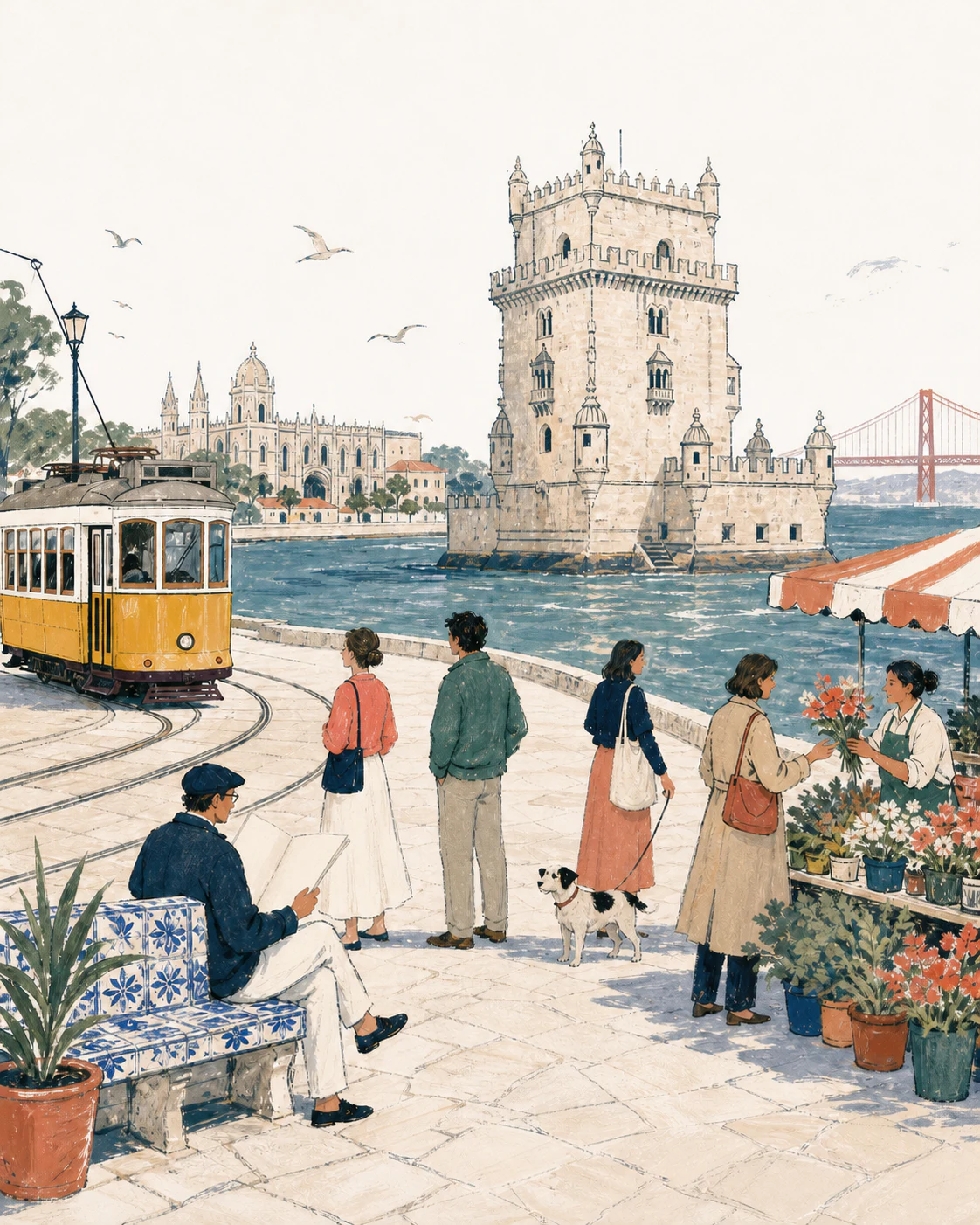
Uses Belém Tower, Jerónimos Monastery, the 25 de Abril Bridge, and a yellow tram to test landmark layering, transport scale, six adults, and text-free public-life detail.Generated example

Lisbon waterfront memory

Uses Belém Tower, Jerónimos Monastery, the 25 de Abril Bridge, and a yellow tram to test landmark layering, transport scale, six adults, and text-free public-life detail.

View full image
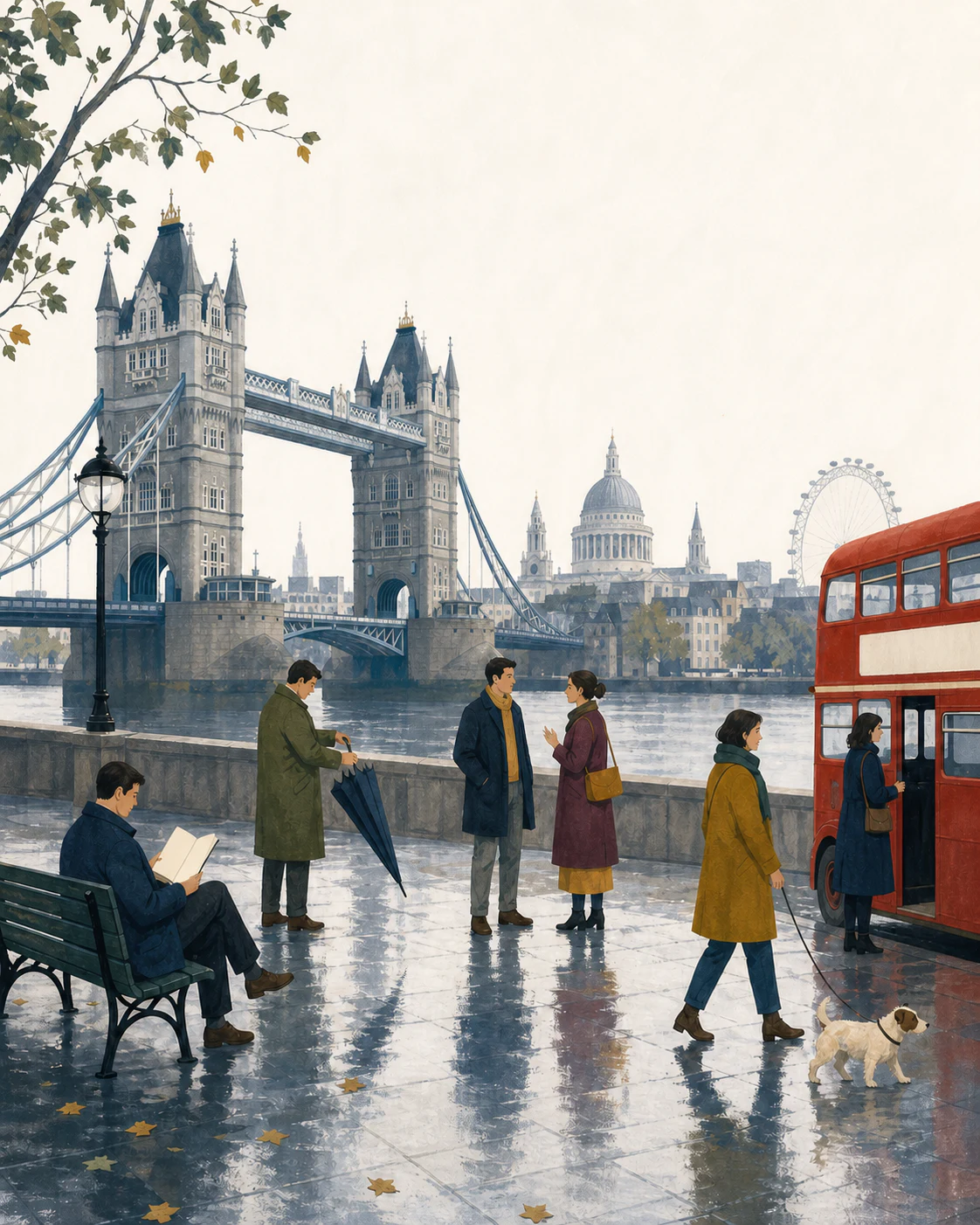
Uses Tower Bridge, St Paul's Cathedral, the London Eye, and a red double-decker bus to test cool-warm color balance, rain-washed space, six adults, and blank-page fallback.Generated example

London riverside after rain

Uses Tower Bridge, St Paul's Cathedral, the London Eye, and a red double-decker bus to test cool-warm color balance, rain-washed space, six adults, and blank-page fallback.

View full image
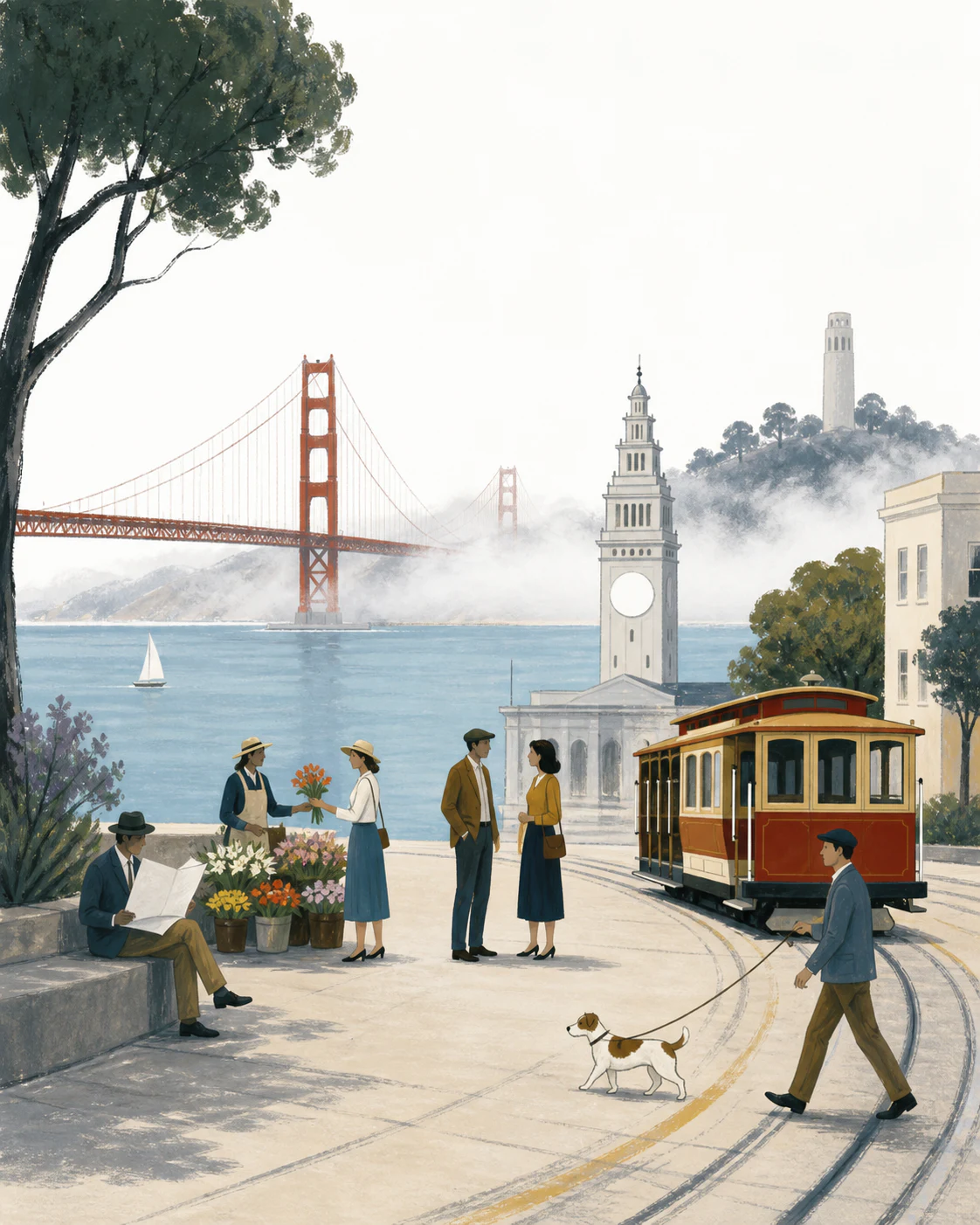
Uses the Golden Gate Bridge, Ferry Building, Coit Tower, and a cable car to test fog-softened recognition, slope perspective, six adults, a blank clock face, and a text-free newspaper.Generated example

San Francisco bay slope

Uses the Golden Gate Bridge, Ferry Building, Coit Tower, and a cable car to test fog-softened recognition, slope perspective, six adults, a blank clock face, and a text-free newspaper.

View full image

Reference images were generated for AI Prompt Card. Results vary by model, settings, seed, and the details you provide.

How to use it

From visual idea to usable image

  1. 1

    Add details when useful

    The prompt works without a form. Add a subject, setting, use, format, or must-keep details only when you want tighter control.

  2. 2

    Generate and inspect

    Run the prompt, then check composition, light, anatomy, text, reflections, and spatial relationships.

  3. 3

    Change one variable at a time

    Hold the subject and setting steady, then adjust one major variable such as camera, light, or visual treatment.

Prompt anatomy

What a reliable image prompt controls

Subject and action

Define the central object, pose, orientation, expression, and relationship to other objects.

Setting and space

Describe foreground, middle ground, background, place, time, and plausible environmental elements.

Composition and camera

Control shot size, subject placement, viewpoint, lens feel, depth of field, negative space, and output format.

Light, material, and color

Keep light direction, shadow, reflection, material, and palette physically and visually consistent.

Negative constraints and boundaries

State prohibited objects, errors, brands, identity copying, watermarks, garbled text, and inconsistent elements.

Frequently asked questions

Can I paste these prompts directly into an image generator?

Check the working-method label first. Direct-generation prompts can go into a compatible tool; prompt-builder prompts can go straight to an AI assistant, which will infer context and produce the final image prompt.

Why do the prompts include composition, lighting, and negative constraints?

Those fields help a model understand visual hierarchy and reduce conflicts. Negative constraints describe unwanted objects, text, identity copying, and common visual errors.

What should I consider when using real people or reference images?

Confirm that you have the necessary rights and consent. Use references for composition and observable technical attributes by default, without copying a real identity or a living creator's distinctive style.

Inspiration source

This prompt is an original adaptation. The source X post appears below, and you can also open it directly on X.

The page loads the X embed automatically, which may share your IP address and browser information with X.
Open original on X

Loading the X post…

Keep exploring
View all image prompts