

Six panels, one product: testing an AI storyboard for physical continuity
A pump bottle, tea canister, and sliding organizer reveal what a product-motion storyboard prompt can preserve across six panels—and what still requires human verification.
A storyboard is useful only when panel six still depicts the product introduced in panel one. Image models often produce a convincing individual frame while quietly changing the pump, lid, hand, component count, or direction of travel between frames. A beautiful grid can therefore fail at the one job a production board must do: explain a continuous action.
We designed the evidence-bounded product-motion storyboard prompt to make those changes inspectable. It asks for exactly six numbered panels, one product identity, one key action, and stable evidence across the sequence. We tested it with a viscous pump, a flexible cork closure, and a rigid sliding mechanism. Each case stresses a different kind of continuity.
What stayed fixed
Before generation, each test defined a small continuity ledger:
- the product's silhouette, proportions, materials, color, and moving parts;
- the action's start state, intermediate states, end state, and direction;
- the hand that enters the scene, including side, grip, and plausible contact;
- the items whose count must remain stable;
- a common camera family, background, and light direction;
- exactly six panels, numbered in reading order, with no extra inset or duplicate hero frame.
This ledger is intentionally narrower than a commercial brief. It does not invent a brand, efficacy claim, package copy, internal engineering tolerance, or off-camera mechanism. When evidence is missing, the board should simplify the action rather than fabricate an authoritative product fact.
We inspected the generated images at original resolution and again after WebP optimization. A case passed only if all six panels were present, the central action was readable, product geometry did not drift materially, hands remained plausible, and the frame contained no branding, pseudo-copy, watermark, or unsafe interaction.
Case 1: amber gel pump and soft-material timing
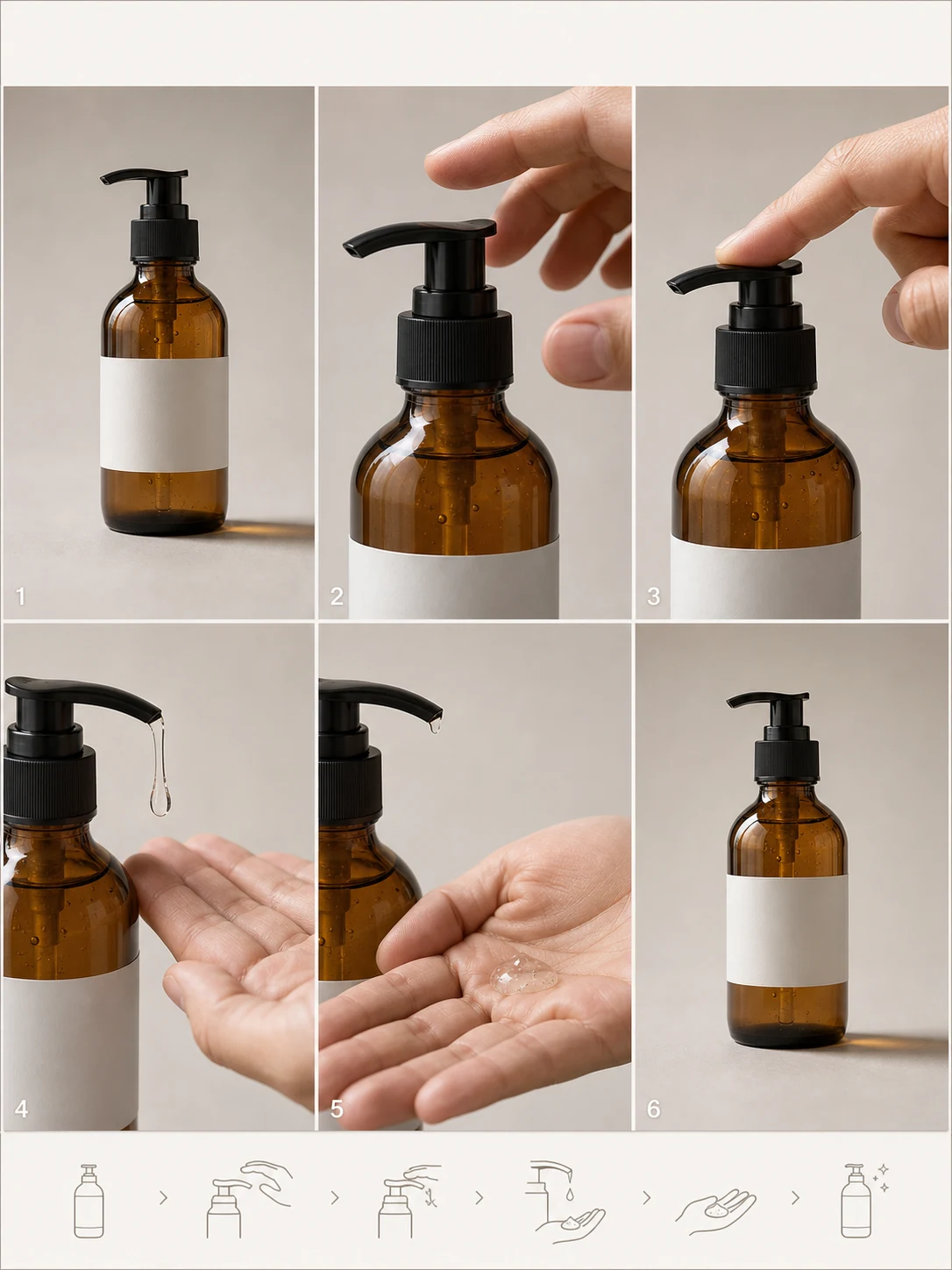
The first test followed a pump press from untouched bottle to gel contacting the palm. This combines rigid continuity—the bottle, neck, and pump geometry—with soft continuity—the gel column must emerge, stretch, separate, and land in a credible order. A common failure would show gel before the pump moves, change the bottle height between panels, or swap the receiving hand.
The accepted board contained six numbered panels and preserved the amber bottle and pump shape through the press-to-palm sequence. The gel behaved as a viscous material rather than a rigid rod, and the hand, lighting, and shadows remained consistent enough to read the action. This does not validate the pump's real dose or the gel's formulation. It only shows that the sequence communicates the intended motion without an obvious visual contradiction.
Case 2: tea canister and closure geometry
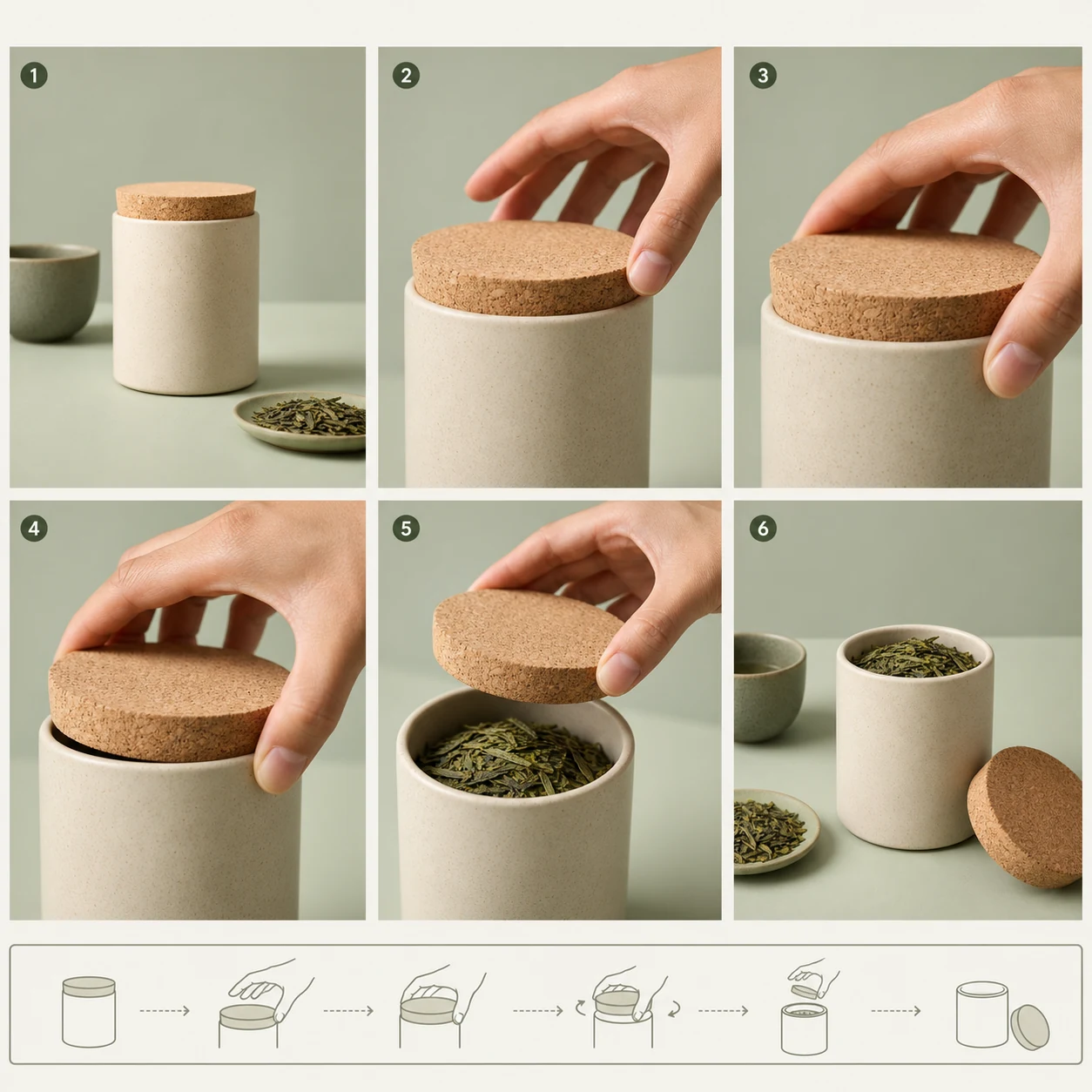
The canister test used a grip, twist, lift, and rest sequence. Its difficulty comes from the relationship between two materials and two geometries: a relatively rigid stoneware body and a softer cork top seated inside an opening. If the opening diameter, lid depth, hand position, or rotation axis changes, the action stops being physically persuasive.
The accepted square board kept one canister identity, one cork closure, six numbered beats, and a coherent transition from closed to lifted. Material contrast remained visible without turning the cork into polished ceramic. The board is useful as previsualization because an art director can point to a specific beat and discuss framing or hand placement. It is not an engineering diagram: no conclusion should be drawn about seal pressure, food storage, or manufacturing fit.
Case 3: aluminum organizer and rigid constraints
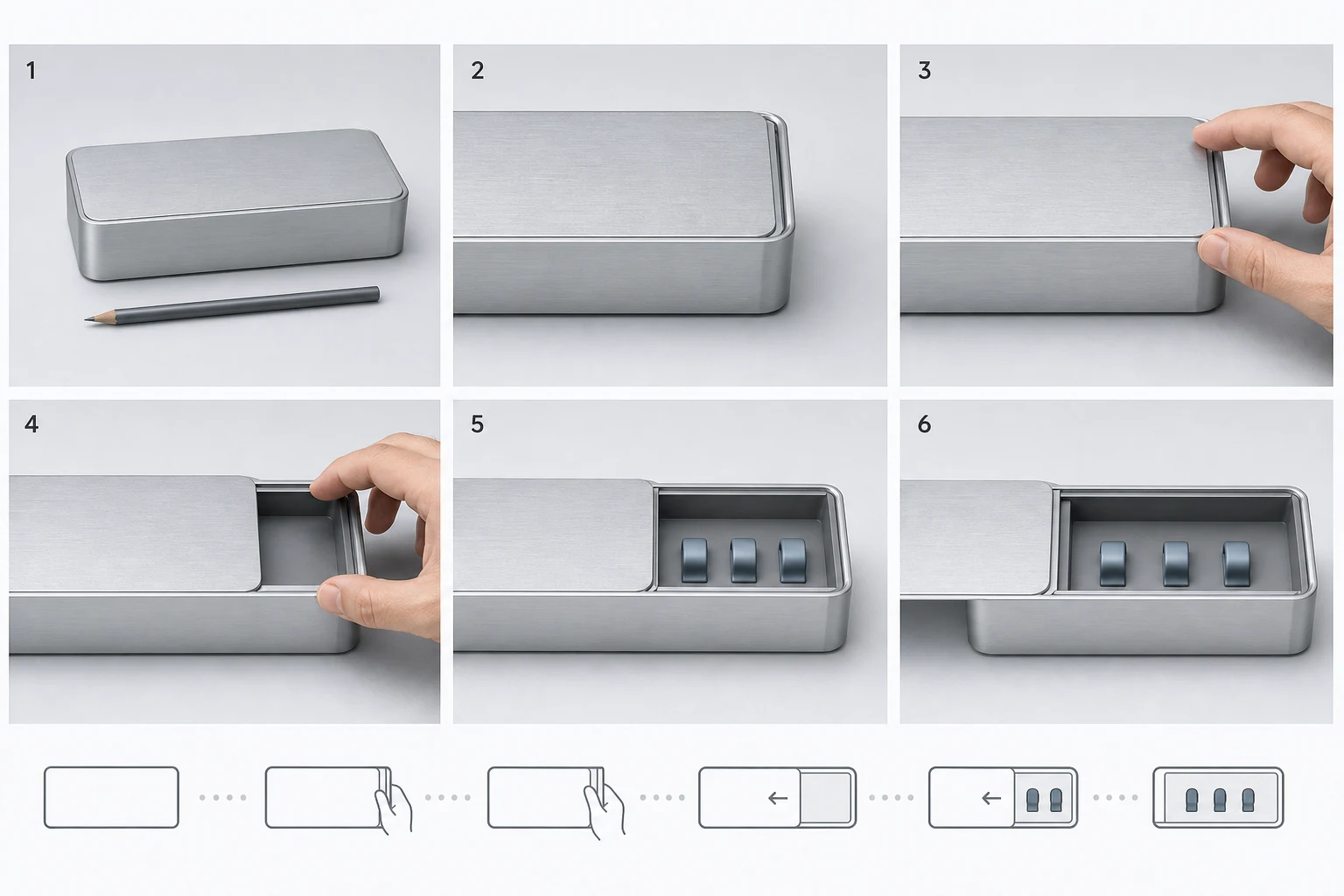
The organizer is the strictest geometry test. Its lid must travel from right to left along a fixed rail, while exactly three clips remain inside whenever the compartment is exposed. A drifting rail, bent lid, fourth clip, or reversed travel direction would be easy to spot and would invalidate the sequence.
The accepted landscape board kept six panels, one organizer, a guided right-to-left lid, and three clips through the visible states. Reflections and shadows remained compatible with an aluminum surface, and the adult hand interacted with the lid rather than passing through it. Compared with the gel case, rigid objects expose small geometry errors more harshly. That makes this test valuable even though it cannot certify the actual rail design or tolerances.
Continuity results
| Continuity dimension | Gel pump | Tea canister | Organizer |
|---|---|---|---|
| Primary action | Press, extrude, contact | Grip, twist, lift | Slide right to left |
| Hardest variable | Viscous gel timing | Lid-seat relationship | Rail geometry and clip count |
| Stable evidence observed | Bottle, pump, hand, light | Canister, cork, hand, opening | Box, lid, three clips, direction |
| Unsupported conclusion | Dose or formula accuracy | Seal or food-storage performance | Mechanical tolerance or durability |
All three cases passed the visible six-panel contract, but they did not pass for the same reason. The pump demonstrates temporal behavior in a soft material. The canister demonstrates closure relationships across contrasting materials. The organizer demonstrates count and direction under rigid geometry. Using varied mechanisms is what makes the set informative; three differently colored pump bottles would provide much weaker evidence.
Where the prompt can still fail
Numbered panels create an appearance of rigor, but numbering is not continuity. Reviewers must compare the first and last panel, then trace each product edge, moving part, hand, and count through the intermediate frames. A board should be rejected when it silently changes product proportions, shows an action before its cause, adds a component, reverses direction, or relies on tiny unreadable labels to explain what happened.
The model may also create a plausible mechanism that was never present in the supplied references. That is why the prompt is evidence-bounded: unsupported internal parts, claims, or package details must be omitted. When a real product is involved, multi-angle references and before-and-after states are more valuable than adjectives such as “premium” or “innovative.”
How to use this evidence responsibly
These boards can help a team discuss shot order, camera coverage, hand choreography, and which product fact needs a close-up before spending time on production. They are not substitutes for industrial design, packaging-rights review, efficacy substantiation, food compliance, or on-set safety planning.
The practical workflow is simple: write the continuity ledger, generate one board, inspect every panel at full size, record the failure or acceptance reason, and keep the exact limitations beside the output. A prompt library adds real value when it exposes that reasoning. The final image alone is the result; the checks explain whether anyone should rely on it.