

Can an exploded food character actually reassemble? A three-scene prompt test
We tested one ingredient-logic image prompt on a bagel, pita, and fruit tart, then checked exact counts, assembly order, material realism, and where visual inspection still falls short.
An exploded-view image can look polished while being structurally meaningless. A berry may appear both on the finished character and in the floating parts; a rear layer may have no path back into the food; or the lighting may change from one ingredient to the next. Those are not cosmetic flaws. They show that the image did not preserve the assembly rule the prompt was meant to communicate.
We built the ingredient-logic edible character prompt around a stricter question: can every visible component be named, counted, and returned to one unambiguous place? We then ran three deliberately different scenes through the same contract. This article records the test, the accepted outputs, and the limits of what those outputs prove.
The test contract
The prompt separates fixed facts from visual choices. Ingredient identity, total count, edible state, one-character limit, and reassembly order are fixed. Camera angle, spacing, background tint, and the exact curve of the exploded axis can vary. This distinction matters because a model needs room to compose, but it should not be allowed to repair a weak composition by inventing extra pieces.
For each scene, we checked five things:
- Inventory: every named ingredient appears at the specified total count, with no assembled duplicate hiding on the body.
- Return path: parts follow one readable axis and could move back to their intended positions without passing through another part.
- Material evidence: crust, sauce, fruit, seeds, and garnish remain visibly different materials rather than converging into glossy plastic.
- Scene continuity: perspective, gravity, highlights, and suspended shadows agree across the whole frame.
- Publication boundary: no brand, packaging, pseudo-text, watermark, unsafe preparation, or non-edible support is visible.
These are visual checks, not laboratory measurements. We can inspect whether a blueberry is present twice; we cannot infer allergen safety, hygiene, nutrition, or whether a photographed recipe would be pleasant to eat.
Case 1: breakfast bagel and the duplicate-part trap
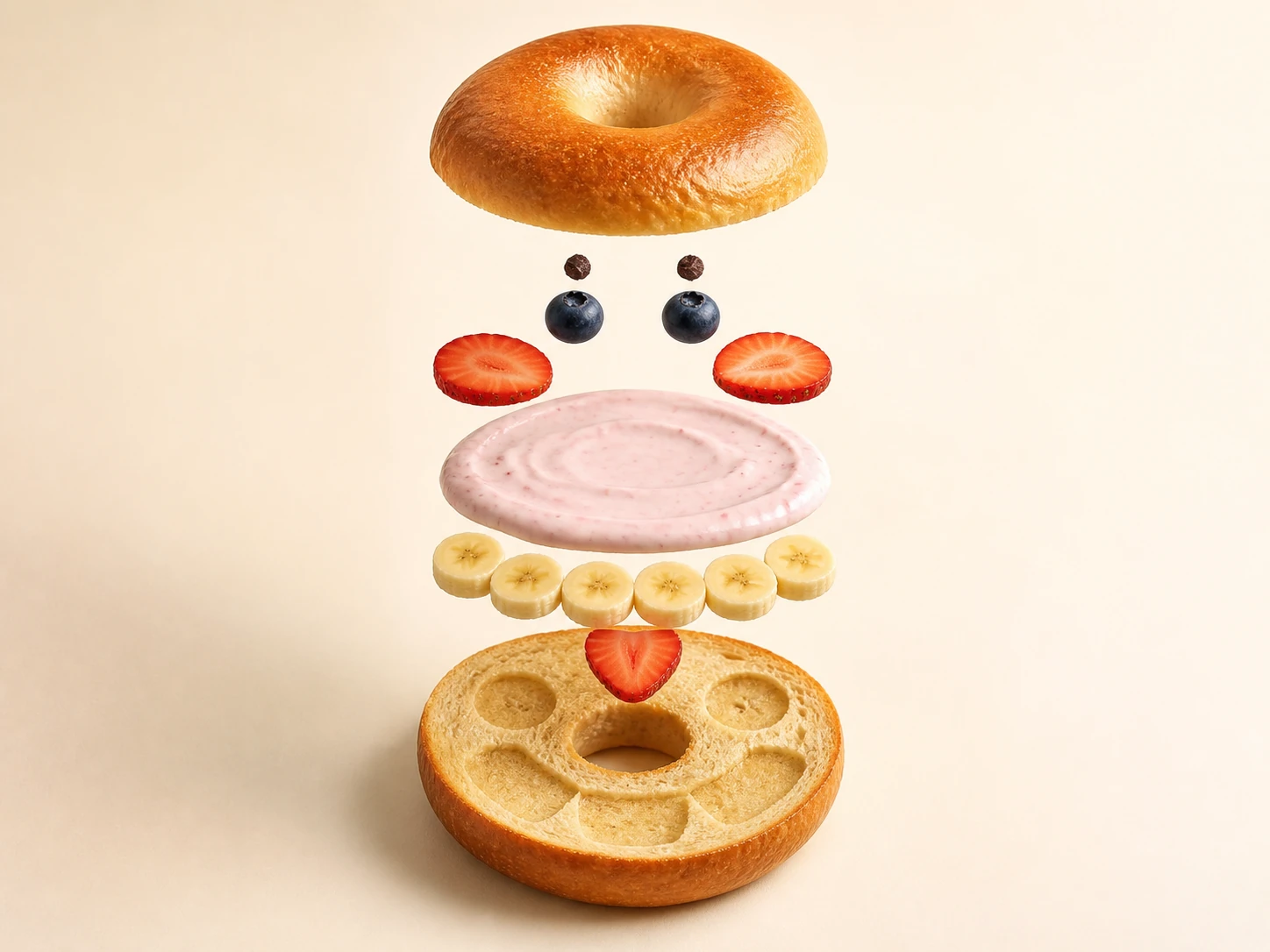
The bagel was the most useful first test because its inventory is easy to audit: one split bagel, one yogurt layer, two strawberry cheeks, two blueberry eyes, two cacao pupils, six banana teeth, and one strawberry tongue. The lower half had to remain empty except for subtle placement areas. If a finished face also appeared on the bagel, the frame would show spare parts rather than an exploded assembly.
The accepted output kept each facial ingredient in the floating path once. The toasted pores, thick yogurt, moist fruit, and dry cacao remained distinguishable, and the component path could be read at thumbnail size. The result is not perfectly mechanical: soft food deforms, and a placement area is an illustrative cue rather than a real connector. But the composition passes the intended communication test because count and destination stay legible.
Case 2: savory pita and mixed-material continuity
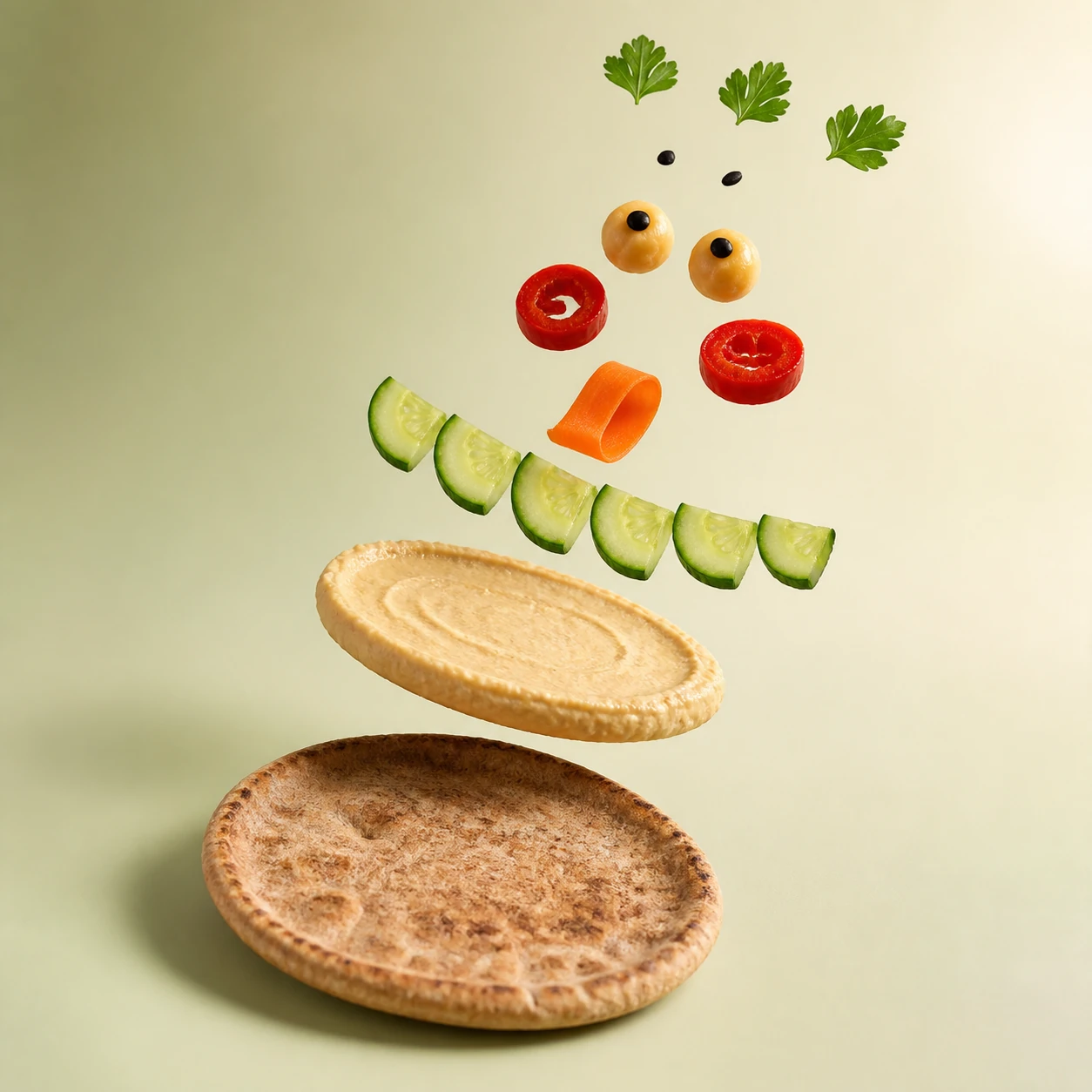
The pita case changed the frame to square and the assembly path to a diagonal. It also introduced a harder material mix: toasted bread, creamy hummus, chickpeas, sesame seeds, roasted pepper, cucumber, carrot, and parsley. The exact inventory was one pita, one hummus layer, two chickpea eyes, two sesame pupils, two pepper cheeks, six cucumber teeth, one carrot tongue, and three parsley leaves.
This scene tested whether the prompt was tied to the colors and geometry of the bagel example. It was not. The diagonal remained readable, ingredient counts stayed discrete, and the light direction was coherent across dry, creamy, and moist surfaces. The smallest sesame pieces are naturally the hardest elements to verify at listing-card size, which is why the detail image and written inventory belong together. A thumbnail alone is insufficient evidence for exact-count claims.
Case 3: fruit tart and vertical negative space
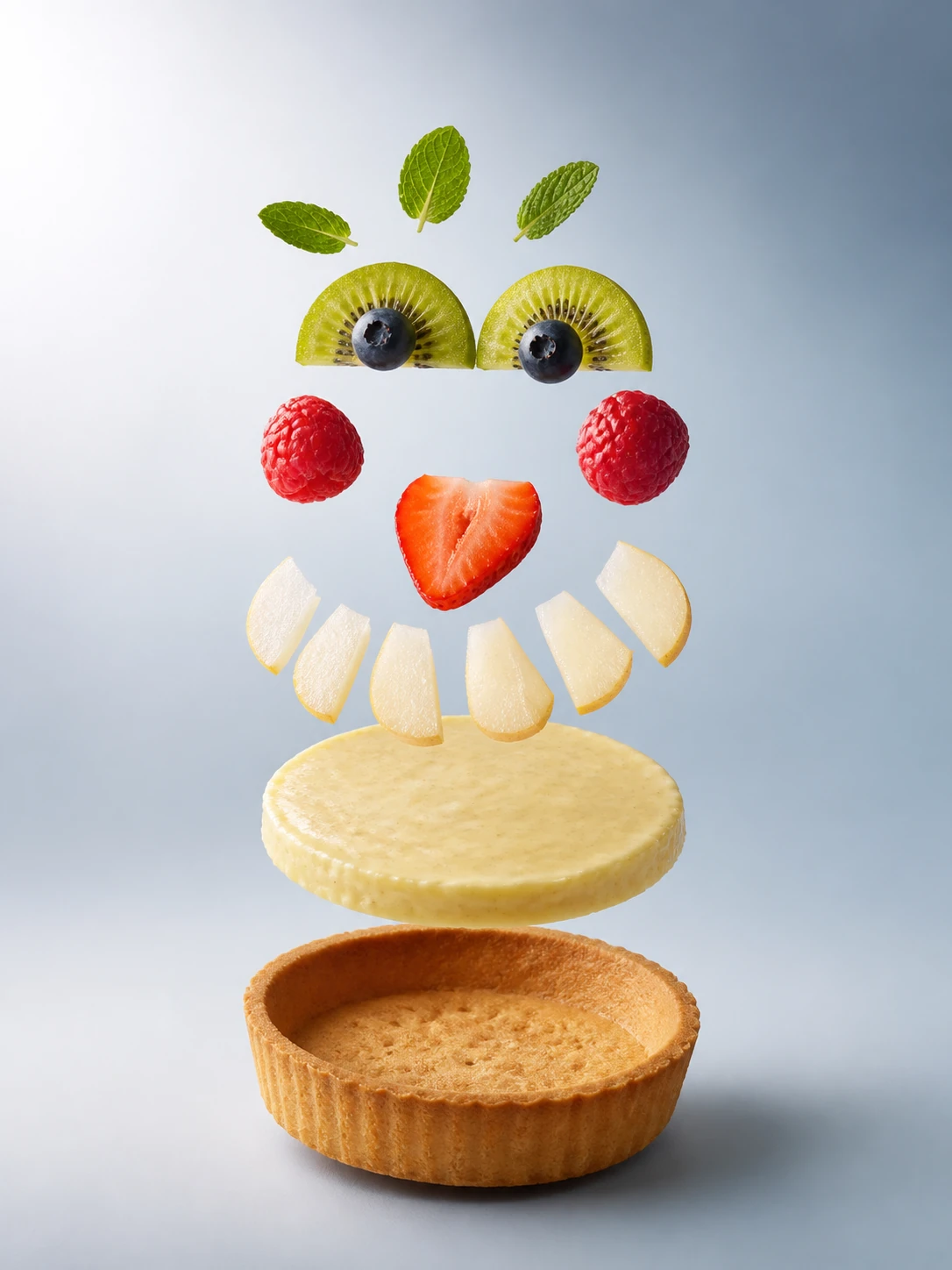
The fruit tart moved to a vertical 3:4 frame. Its sequence used one baked tart shell, one cooked oat-custard layer, two kiwi eyes, two blueberry pupils, two raspberry cheeks, six pear teeth, one strawberry tongue, and three mint leaves. The goal was to see whether the same rules could survive a tall layout without turning the upper half into random floating garnish.
The gentle S-shaped path uses the available height while keeping the tart as the visual anchor. Pastry texture remains dry and porous, while the custard and fruit carry softer highlights. The accepted frame preserved the specified counts and avoided a second assembled face. It also reveals a practical constraint: generous vertical spacing improves sequence readability, but excessive spacing would make the parts feel unrelated. The prompt can bound that tradeoff; a human still needs to judge it.
What the three outputs tell us
| Question | Bagel | Pita | Tart |
|---|---|---|---|
| Exact inventory readable | Yes at detail size | Yes; sesame needs detail view | Yes at detail size |
| One returnable component path | Shallow curve | Diagonal curve | Vertical S curve |
| Material contrast preserved | Baked, creamy, moist, granular | Baked, creamy, fresh, roasted | Pastry, custard, moist fruit |
| Layout stress tested | Landscape 4:3 | Square 1:1 | Vertical 3:4 |
The useful result is not that all three pictures are attractive. It is that one reusable rule set survived changes in food, material, axis, and aspect ratio without losing its central inventory-and-reassembly contract. That is stronger evidence than publishing three near-identical color variants.
It is still limited evidence. Three accepted scenes do not demonstrate universal model reliability. They do not cover soups, translucent containers, branded packaging, culturally specific dishes, or foods whose components cannot be visually separated. The images were generated through our image workflow, inspected at original resolution, optimized to WebP, and checked again after upload. That process detects visible defects; it does not certify the food or the model.
A reusable review method
If you adapt the prompt, write the ingredient inventory before asking for the image. Give every visible part one role and one total count. After generation, review the body and the floating path together, not separately. Reject the output when a piece appears twice, lacks a destination, changes material, breaks the common light, or depends on text to explain the assembly.
Most importantly, record what the image does not prove. A clear exploded scene can support a menu concept, campaign sketch, or visual exercise. It cannot replace food-safety, allergen, nutrition, trademark, or advertising review. Keeping that boundary visible is part of the prompt's quality, not a footnote added after the picture looks good.